Call us at +1 (844) 777-4287
 info@meinhaus.ca
 Team
Team
 05 January 2026
How and Why Pro Data is the Operating System
Data Is the Operating System
Why MEINHAUS tracks “everything that matters” on the professional side—and why an integrated CRM changes the game
In home services, most companies think their biggest problem is lead flow. In reality, the bigger problem is governance:
-
Who is actually eligible to take work?
-
Who is reliable at scale?
-
Who is active right now?
-
Who can respond quickly in a specific region?
-
Who should be offered which opportunities—and when?
If you can’t answer those questions with speed and confidence, your business ends up running on gut-feel, spreadsheets, and constant firefighting.
That’s why data isn’t a “nice to have” for MEINHAUS. It’s the infrastructure layer that makes outcomes repeatable.
The core idea:
-
data turns a network into a system
-
A database of professionals is not automatically valuable.
-
A structured dataset of professionals—connected to operational signals and built into an integrated CRM—is what becomes valuable.
The difference is simple:
A list tells you who exists.
A CRM system tells you who is eligible, ready, reliable, nearby, and best suited—right now—and what action to take next.
That’s how you move from “finding people” to “running an operating system.”
What an integrated CRM actually does (beyond storing contacts)
An integrated CRM (built directly into the delivery platform) has two jobs:
1) Filter the supply side by real variables
Not vanity metrics. Not “I think he’s good.”
But actual signals that impact outcomes: compliance, engagement, capability, location, performance, responsiveness.
2) Turn those filters into actions
Filtering alone is just reporting.
The real value is when the system lets you do something immediately based on what you’ve filtered:
-
assign a job
-
resolve a live project issue
-
trigger a compliance follow-up
-
send targeted announcements
-
offer complementary services
-
re-activate inactive professionals
-
reduce churn and increase engagement
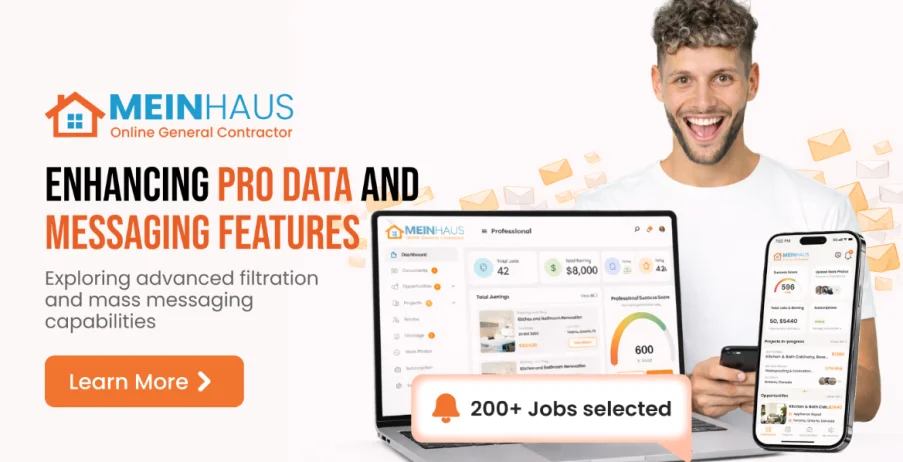
This is exactly what our professional-side admin CRM is built to do (the attached screenshot from our test environment shows the direction of this).
The MEINHAUS professional-side variables we track—and why each one matters
Below are some of the key filters we maintain today, and the specific operational and growth actions they enable.
1) Registration status: Premium vs Free
What it tells us: Relationship Depth and Monetization Tier.
What it enables:
-
Prioritized opportunity routing (where appropriate)
-
Targeted renewal campaigns
-
Feature gating + upgrade offers tied to real usage
-
Better forecasting of supply reliability (premium pros often show higher engagement)
2) Verification status and missing documents
What it tells us: Eligibility and Risk Exposure.
We track whether documents are uploaded, verified, expired, or missing—and which ones. This can also include whether a pro has completed partner-driven steps (for example, insurance-related confirmations or quote-alignment workflows, where applicable).
What it enables:
-
Instant eligibility checks before job assignment
-
Automated “missing document” chase sequences
-
Reduced liability and fewer mid-project compliance surprises
-
More consistent homeowner experience
-
This is one of the biggest differences between a marketplace and a governed platform: compliance becomes measurable and enforceable.
3) App Download Status
What it tells us: If the Pro has the MEINHAUS Pro App downloaded, How operationally “connected” a pro is.
What it enables:
-
In-app job delivery vs manual follow-ups
-
Better response time and lower admin overhead
-
Targeted “download the app” onboarding only to those who haven’t
-
For operations, this matters because platform adoption directly affects throughput.
4) Push notifications enabled
What it tells us: whether we can reach the pro in real time through push notification
What it enables:
-
Faster dispatch and job fill rates
-
Fewer “no response” situations
-
Targeted messaging:
-
“Enable push to receive urgent jobs”
-
“Confirm availability” prompts
-
location-based opportunity blasts
-
This is a perfect example of turning a data point into an operational advantage.
5) Rating range / proprietary success score
What it tells us: reliability and outcome probability, not popularity.
Instead of relying solely on subjective reviews, a proprietary success meter can incorporate signals like:
-
Compliance with Monetization System
-
Scope Adherence
-
Communication Reliability
-
Warranty Callbacks
-
Dispute flags (if any)
-
Documentation completeness (photos, updates, approvals)
What it enables:
-
Better job-to-pro matching (risk and complexity fitting)
-
Less rework and fewer escalations
-
Rewarding compliance and performance with higher-quality opportunities
-
Objective coaching: “here’s what moves your score”
-
This is how the platform encourages the behaviors that produce better outcomes.
6) Jobs completed vs none
What it tells us: proven delivery capacity within our system.
What it enables: Separating “new” from “proven” supply for higher-risk jobs
Targeted activation:
-
“You’re approved—here’s your first project”
-
Better forecasting of throughput by region and service type
7) Last login / project views / activity recency
What it tells us: current engagement and likelihood of response.
What it enables:
-
Reactivation campaigns for dormant pros
-
Prioritizing engaged pros for time-sensitive work
-
Identifying churn risk early (before they disappear)
-
This is the difference between “we have 8,000 pros” and “we have 800 active pros this month.”
8) Services registered to receive opportunities in
What it tells us: skill alignment and service capacity.
What it enables:
-
Service-specific dispatch (no wasting time blasting everyone)
-
Launching new service lines region-by-region
-
Cross-selling adjacent services to proven pros
-
(ex: a painter adding drywall repair, trim, or minor carpentry if qualified)
-
Operationally, this reduces noise and increases conversion.
9) Location filters: city, province, or geo-radius
What it tells us: who can physically deliver the job.
What it enables:
-
“Within X km” dispatch for urgent work
-
Regional expansion planning
-
Targeted recruiting only where supply is thin
-
Better logistics, lower travel waste, more consistent scheduling
-
This matters both for customer experience and margin control.
Why this helps operations on live projects
When you’re running active renovations, you’re not just “assigning jobs.” You’re managing time, risk, schedules, and humans.
With integrated professional data, the team can instantly answer:
-
Who is eligible today, with verified docs?
-
Who is active this week and responding quickly?
-
Who has done this job type successfully before?
-
Who is closest to the project location?
-
Who should be escalated or replaced if needed?
This reduces:
-
delays
-
rework
-
disputes
-
admin time
-
homeowner uncertainty
It’s not just reporting—it’s operational control.
Why this also drives growth and monetization
Once you have structured supply-side data, you can do more than dispatch jobs.
You can:
-
pitch complementary services to the right pros (not everyone)
-
upsell premium tiers based on demonstrated engagement
-
create partner programs with targeted cohorts (by service, location, and performance)
-
build repeatable outreach sequences that feel relevant (because they are)
The key is selective messaging:
Instead of broadcasting, you segment.
And segmentation is what turns a large network into a monetizable platform.
Important note: “track everything” still requires trust and consent
Collecting many data points only creates value if:
-
the data is accurate
-
professionals understand why it’s being collected
-
messaging respects consent and user preferences
-
information is secured and handled responsibly (privacy + security best practices)
The win is not surveillance—the win is clarity and reliability.
MEINHAUS tracks professional-side data because it unlocks two compounding advantages:
Better outcomes through governance (compliance, fit, reliability, verification)
Better economics through targeted actions (efficient dispatch, retention, and complementary monetization)
In a fragmented industry, data isn’t “analytics.”
It’s the operating system.